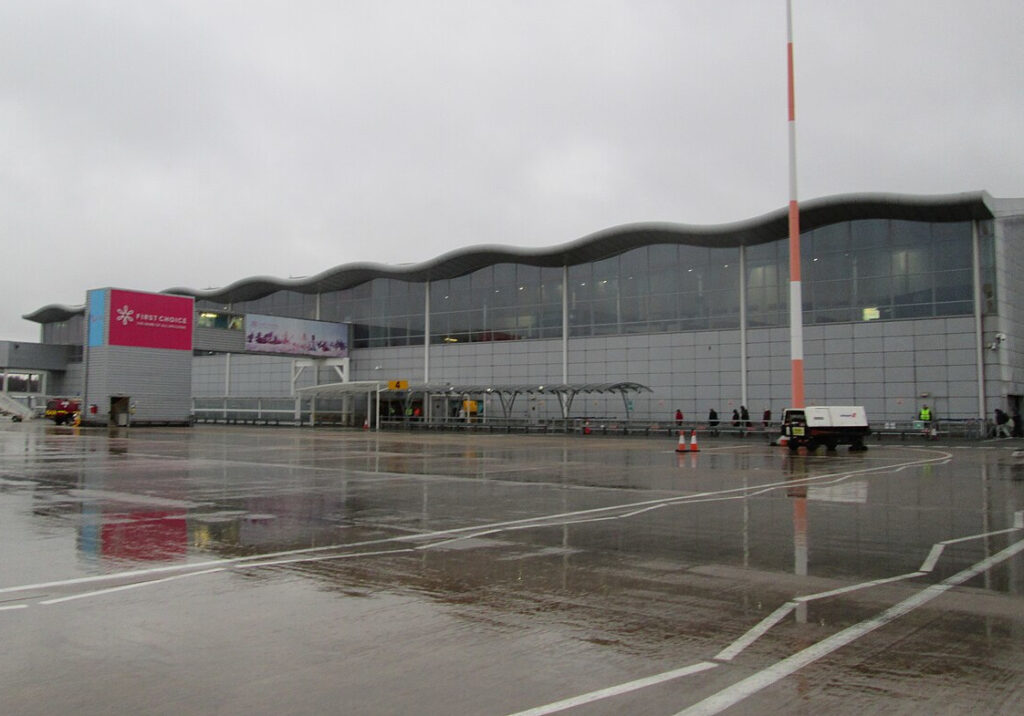

A public consultation has opened on how Doncaster Sheffield Airport (DSA) would manage its airspace if it reopens — covering the flight paths planes would use, how many flights are expected, and what the changes could mean for noise, jobs and the local economy. The consultation runs from Monday 3 August to Sunday 4 October 2026.
DSA has been closed since November 2022, when its previous operator withdrew. Its reopening is now the centrepiece of South Yorkshire Airport City (SYAC), a regional growth programme intended to restore aviation services and create jobs across advanced manufacturing, engineering, logistics and green technologies. The programme is being delivered through a partnership between national government, the South Yorkshire Mayoral Combined Authority and City of Doncaster Council (CDC).
Since the airport closed, no commercial flights have operated to or from the site. The only current aviation activity is a small number of movements by 2Excel Aviation, approved by CDC, which do not carry passengers or cargo. The airport remains unlicensed, meaning it cannot handle commercial flights with fare-paying passengers or larger-aircraft flying training — a licence from the Civil Aviation Authority (CAA) is currently being pursued by CDC.
Airlines have told the airport they will not operate from DSA until a safe and efficient airspace structure is back in place — which is what this Airspace Change Proposal (ACP) is intended to deliver. When the airport closed, its controlled airspace and flight procedures were removed too: the CAA began that removal process in October 2022, and completed it in September 2025. The site currently has no active air traffic control service, no published arrival or departure routes, and no regulated airspace protection for aircraft arriving or departing.
How we got here
Changes to UK airspace have to go through the CAA’s Airspace Change Process, known as CAP1616 — a seven-stage framework, with the CAA checking progress at defined points called gateways. CDC’s proposal has been under way since September 2024, and has already passed through several of those stages:
An initial Statement of Need was submitted to the CAA, followed by an assessment meeting, and six Design Principles were developed with stakeholder representatives to provide a framework for evaluating design options. One early option — reinstating the exact routes and airspace DSA had in 2022 — was shared with stakeholders for feedback, which led to three further options being developed. One of those four was later dropped for not meeting the original Statement of Need, leaving three that were tested against the Design Principles at a Design Principle Evaluation.
That evaluation eliminated one more, leaving two options that went forward to an Initial Options Appraisal, assessed against noise, environmental, aviation and cost impacts, measured against a baseline of no flights operating from DSA at all. Both options passed that stage and were carried into Stage 3, where they were refined — and renamed Option 2 and Option 3 — based on more detailed airspace integration, preliminary flight procedure design and safety requirements, before being taken to a more detailed, quantitative assessment called a Full Options Appraisal.
That appraisal found that, on balance, Option 3 offered greater benefits for safety, controlled airspace and integration with the wider airspace and neighbouring airports, though results varied on noise and greenhouse gas emissions. Option 3 is the design now going out to public consultation. The CAA approved CDC’s Stage 1 and Stage 2 submissions in May 2026, and approved the airport to launch this public consultation — Stage 3 — in July 2026.
Looking ahead, CDC plans to submit its final proposal to the CAA in January 2027, incorporating feedback from this consultation. The CAA is expected to make its decision in May 2027, with implementation planned for spring 2028. DSA is separately expected to reopen for some freight movements in 2027 that would not require this airspace change.
What’s being proposed
Doncaster Sheffield Airport has a single runway that can be used in two directions, known as Runway 20 and Runway 02 — aircraft always take off and land into the wind, so the prevailing wind direction determines which is in use. Runway 20, used for around 60–70% of the year (roughly 219 to 255 days), sends aircraft south. Runway 02, used the remaining 30–40% of the year (roughly 110 to 146 days), sends them north.
Departing aircraft, regardless of which runway is in use, would route towards one of two waypoints — named UPTON and ROGAG — before joining the wider network airspace. Most aircraft would be expected to fly Performance Based Navigation (PBN) routes, which use satellite-based waypoints to follow an accurate, consistent flight path. Aircraft not yet equipped for PBN, or requiring air traffic control intervention for safety reasons, would instead be “vectored” — given individual routing instructions by air traffic control, which produces a wider spread of flight paths across the airspace rather than a single concentrated line.
Arriving aircraft are expected to come mainly from the southwest, though DSA says aircraft could arrive from other directions too. To help aircraft land, the airport plans to install an Instrument Landing System, along with a satellite-based alternative.
How many flights to expect
DSA has published projections for both the year the new airspace would take effect (2028) and ten years on (2037). In 2028, the airport expects a total of 1,841 arrivals and departures across the year, averaging three arrivals and three departures on a typical day. By 2037, that rises to a projected 12,329 arrivals and departures a year, averaging 17 arrivals and 17 departures a day.
Broken down by type of flight, DSA expects 1,002 passenger flights carrying 155,412 passengers, and 839 cargo flights, in 2028 — rising to 8,189 passenger flights carrying 1,169,538 passengers, and 4,140 cargo flights, by 2037. The 4,140 figure is a ceiling, not just a projection: an existing planning agreement limits DSA to that many cargo flights per year.
On the busiest summer days, DSA expects up to around 28 arrivals or departures using either runway by 2037, though the airport stresses these figures are based on a “worst case” busy-day scenario and actual numbers would vary through the year.
The benefits, and the costs
DSA’s own assessment, carried out for this consultation, sets out the proposal’s positive and negative effects across a range of categories, measured against a baseline of no flights operating from DSA at all:
Noise is expected to increase for some areas around the airport — DSA says the fuller noise contours and affected population figures are set out in its more detailed community-facing consultation document. Air quality impact is expected to be negligible. Flying will produce greenhouse gas emissions from fuel burn, though the airport says flights would have no impact on National Parks or Areas of Outstanding Natural Beauty below 7,000 feet, protecting tranquillity in those areas. A specialist habitats assessment found no significant expected effects on biodiversity, designated habitats, flora or fauna.
The proposal also includes procedures for resilience — covering navigation aid outages, and alternative procedures for aircraft not yet equipped with the latest technology.
On safety, DSA says no risks have so far been identified that it considers intolerable, and the design is expected to integrate well with neighbouring airports and the wider NATS airspace — the network run by National Air Traffic Services, the UK’s main air navigation provider. The proposal is not expected to add costs for airlines, though DSA itself will face deployment, infrastructure and ongoing operational costs, including for its air navigation service provider. The plans could also affect general aviation users — private light aircraft, gliders, paragliders, parachutists, microlights, balloons and helicopters — through the introduction of new controlled airspace.
The economics
DSA converted several of these impacts — noise, greenhouse gas emissions, fuel burn, economic benefits and operational costs — into monetary terms, as required by the CAP1616 process, to calculate a Net Present Value for the proposal. That assessment found a benefit of around £542 million over ten years, after accounting for inflation and discounting.
DSA says this figure doesn’t capture the airport’s full long-term economic effect. Separate estimates cited in the consultation document suggest reopening DSA could boost the economy by approximately £5 billion by 2050, with a further £2 billion in wider economic benefits over the same period, and support more than 5,000 direct jobs across aviation, logistics, engineering, construction and local businesses.
Have your say
The consultation closes at 23:59 on Sunday 4 October 2026. Responses must be submitted through the DSA Citizen Space consultation website, at consultations.airspacechange.co.uk/doncaster-airport/dsa-airspace, where the full consultation documents are also available — including a more accessible community and local area interest document, and a more technical aviation interest document aimed at airlines, general aviation pilots and other airports.
DSA is running a series of webinars and in-person drop-in events. Webinars on communities and environmental interest run on 17 August (16:00–19:30), 3 September (11:00–12:30), 23 September (17:30–19:00) and 25 September (11:00–12:30), alongside a general aviation and controlled airspace webinar on 14 August (11:00–12:30); registration is via DSA-airspaceconsultation@flydsa.com. In-person drop-in events, which can be attended at any time within their advertised hours without booking, are being held at Bawtry Mayflower Primary School on 13 August (14:00–19:00), St Joseph’s Parish Centre in Worksop on 19 August (14:00–19:00), Finningley Village Hall on 2 September (14:00–19:00), Thorne Rugby Club on 10 September (14:00–19:30), and The Corn Exchange in Doncaster city centre on 19 September (10:30–14:30).
Further questions can be sent to DSA-airspaceconsultation@flydsa.com, or by phone on 0800 043 3099, or by post to DSA Airspace Consultation, c/o Heyford House, First Avenue, Finningley, Doncaster, DN9 3RH. All responses to the consultation, including those submitted in hard copy, will be published on the CAA’s Citizen Space portal. DSA says it will collate and categorise responses into those that may lead to a change in the design and those that would not, and will publish a Consultation Response document summarising what it received and how it responded.