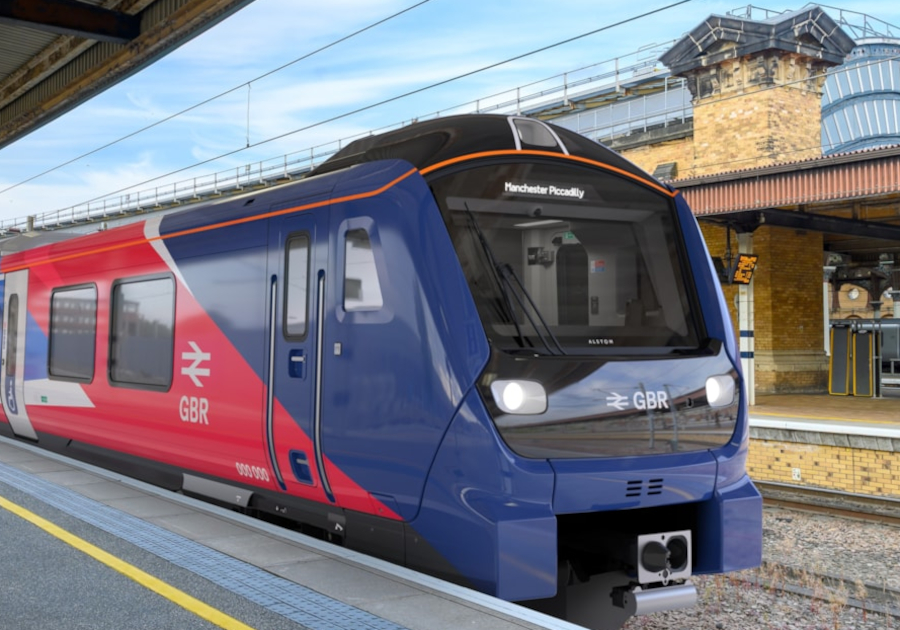

A £1 billion order for 29 new battery-electric trains has been announced for the TransPennine Express network, with Hull and East Yorkshire’s mayor hailing the region’s inclusion as a sign it’s no longer being treated as, in his words, “the end of the line.”
The Adessia Stream trains, manufactured by Alstom at its Derby site on Litchurch Lane, count among the earliest battery-electric trains due to run on a UK main line, serving routes connecting Liverpool, Manchester and Manchester Airport with Leeds, Hull, York, Scarborough and Saltburn. The order forms part of the wider £11 billion Transpennine Route Upgrade, which is electrifying the railway between York and Manchester and has already electrified a quarter of its 70-mile route.
The trains are estimated to enter service by winter 2034, says Network Rail.
New charging infrastructure
Each of the five-carriage units will hold 300 seats overall, with three wheelchair bays and matching companion seats, four onboard toilets (a pair of them fully accessible), a family-friendly accessible area, and space for four bikes, alongside Wi-Fi, power sockets at every seat, and level boarding at the doors to allow passengers to get on and off independently at most stations on the network. New charging infrastructure is planned at Hull, Scarborough and Saltburn.
Mayor Luke Campbell, who joined rail industry partners at Alstom’s Derby works for the announcement, said: “This is a good day for Hull and East Yorkshire. We’ve had some frustrating rail announcements in the past where our region has felt left behind, so seeing us firmly part of this £1 billion investment really matters. I’ve said since I became Mayor that Hull and East Yorkshire cannot keep being treated like the end of the line.
“I’ve been making our case to Government, other Northern Mayors and the rail industry, and the team at HEYCA has been doing the detailed work behind the scenes on passengers, freight, our ports, businesses and what better connections can unlock for growth. I’ve never been interested in talking for the sake of it. I’d rather get on with the job and show people progress. This is exactly the kind of progress we’ve been pushing for. These new trains will mean a much better passenger experience and a big step forward on accessibility.
“But for me this is bigger than the trains. Better links to Leeds, Manchester and the rest of the North mean more opportunities for our people, help businesses reach new markets and make Hull and East Yorkshire a stronger place to invest. This is a big first step, but it has to be the start, not the finish. We’ll keep pushing for faster journeys, better reliability and the capacity our region needs to grow. People here should not have to accept weaker connections than other parts of the North. We’re here to get things moving, and that’s exactly what we’ll keep doing.”
James Richardson, Managing Director at the Transpennine Route Upgrade, said: “TRU is transforming train travel across the north, and today’s announcement is a major step for the programme as we work to deliver a railway that better connects our communities. The £1 billion investment reflects a genuine commitment to transforming rail travel across the region and beyond. A stronger North depends on better connections, and TRU is bringing the north together and unlocking opportunities.”
A transformational investment
Chris Jackson, Managing Director at TransPennine Express, added: “This is a transformational £1 billion investment in the future of rail travel across the North, delivering new trains for our customers alongside new infrastructure, new jobs and long-term economic benefits. Our customers will benefit from more seats and better accessibility, including level boarding. Britain has a proud railway heritage, and this project puts the UK at the forefront of the next generation of cleaner rail technology.”
Once finished, the wider Transpennine Route Upgrade is expected to cut journey times by up to 10 minutes between Manchester and Leeds and 14 minutes between Manchester and York, lift capacity by 30%, and improve accessibility across stations on the route.
The programme currently employs around 5,000 people, with a target of 8,000 over its lifetime, and has already put more than £1 billion into supporting local businesses. The 29 trains are being built by Alstom and will run under TransPennine Express and, eventually, Great British Railways, with financing provided by Rock Rail’s Next Generation Rail Fund, co-managed with Aberdeen Investments.