
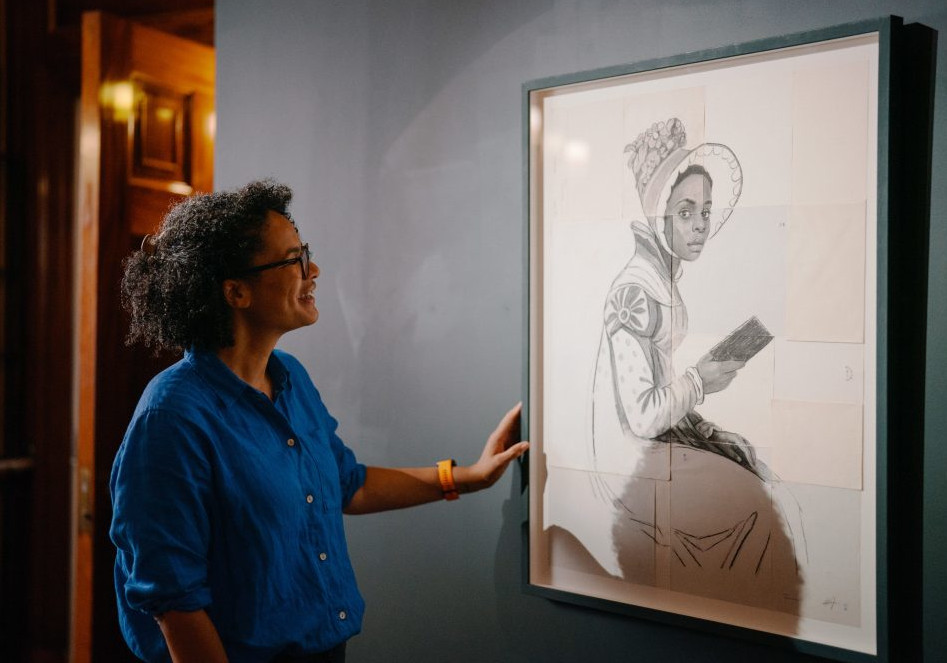

Exactly a year after contemporary artist Lela Harris unveiled her portrait of Miss Lambe, Jane Austen’s only character of African descent, Harewood House Trust has acquired the work into its permanent collection, along with four of Harris’s preparatory collages.
Miss Lambe is drawn from Sanditon, the novel Austen left unfinished when she died in 1817. Austen describes her as a wealthy young heiress who had “a maid of her own, was to have the best room in the lodgings, and was always of the first consequence in every plan” — a fortune that draws the attention of characters hoping to acquire it through marriage. Because Austen died before finishing the novel, Miss Lambe’s story was never told.
The portrait was originally commissioned as part of Harewood’s 2025 exhibition, Austen and Turner: A Country House Encounter, produced with the University of York’s Centre for Eighteenth Century Studies. Harris created it during a creative residency at Harewood, developed in response to the exhibition and to the handwritten manuscript of Sanditon, on loan from King’s College Cambridge.
Harris said: “Working through collage gave me a way to imagine the life Austen only begins to sketch out in her unfinished novel Sanditon. By bringing together fragments from different centuries, I imagined Miss Lambe not just as a fictional character, but as a real young mixed-heritage woman moving through Harewood with all the complexity, vulnerability and resilience that would have entailed in the early nineteenth century. The final charcoal portrait became a way of holding together fact, speculation and feeling. I used Austen’s descriptions of Miss Lambe as ‘precious’, ‘chilly’ and ‘tender’ as an anchor, while allowing the gaps in her story to remain visible. Through this approach, I wanted to centre a presence where the historical record so often falls silent.”
The portrait itself is deliberately unfinished, echoing both the incomplete state of Sanditon and the historic erasure of Black women from archival records. Its surface is pieced together from stationery held in Harewood’s own collection.
The portrait proved hugely popular with visitors during the Austen & Turner exhibition — inspiring fan art of its own — and now returns to display in Harewood’s Music Room, alongside four of Harris’s preparatory collages, where the works will remain for the 2026 season and beyond.
The acquisition was made with support from the Arts Council England/V&A Purchase Grant Fund and Art Fund. It joins a collection of British portraiture at Harewood that includes work by artists from Joshua Reynolds and Thomas Gainsborough to Alfred Munnings and John Singer Sargent.
Redressing the historic lack of diversity in that collection is a stated priority for Harewood, through new acquisitions and initiatives such as its Missing Portraits series — which has most recently included commissioning a new portrait of the British actor and writer David Harewood OBE, whose ancestors were enslaved by the Lascelles family.
Harris said: “I’m truly honoured that my portrait of Miss Lambe has found a permanent home at Harewood. The work began as an act of imagining a presence that history only hints at, so for it to now become part of the house’s collection feels especially meaningful. I hope it encourages conversations about the lives that have shaped places like Harewood and reminds us that there are always stories waiting to be seen, questioned and reimagined.”
Rebecca Burton, curator and archivist at Harewood, said: “We are incredibly excited to acquire Lela Harris’ portrait of Miss Lambe into Harewood’s permanent collection following its hugely popular debut during our 2025 exhibition, Austen & Turner. The acquisition represents an important addition to Harewood’s collection, becoming its first formal portrait of a Black woman. Whilst the sitter is fictional, Austen’s character – a free Black heiress – stands to enrich our understanding of the Black presence in both Regency Britain and the British Country House. Through her portrait of Miss Lambe, Harris makes visible this community and challenges perceptions of the Black female experience during this historical period.”
Professor Jennie Batchelor, head and professor of English at the University of York and co-curator of the Austen & Turner exhibition, said: “Lela’s magnificent portrait of Jane Austen’s most enigmatic character comes back to Harewood at a significant moment as we take stock of Austen’s enduring legacies following the 250th anniversary of her birth. Increasingly, our sense of those legacies have been enriched and complicated by a deepening understanding of what Austen’s novels reveal or conceal about the world in which she lived. Lela’s stunning portrait of Miss Lambe makes an important intervention into this continuing conversation by quite literally surfacing the complex and brutal colonial foundations of Jane Austen’s world.”

