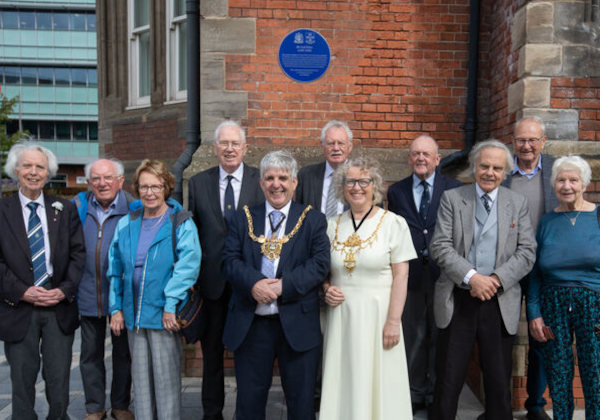

A little-known chapter in the story of penicillin is being marked in Sheffield, with a new plaque honouring the scientist who first successfully used the drug to treat human infection.
Alexander Fleming’s 1928 discovery of penicillin is well known, but it was a University of Sheffield pathologist, Cecil George Paine, who first documented its successful therapeutic use — work now credited as paving the way for a treatment estimated to have saved 82 million lives worldwide. The new plaque has been installed at the university’s Jessop Building, a former Victorian hospital, in Paine’s honour.
Paine joined the university’s Pathology Department as a lecturer in 1932, but it was two years earlier, in 1930, that he made his mark on medical history, using a crude, unpurified form of penicillin to treat eye infections in two babies and a miner — using mould supplied directly by Fleming, who had taught Paine at St Mary’s Hospital Medical School in London. Fleming had identified penicillin’s antibacterial properties in 1928, but hadn’t yet pursued its use as an actual therapy.
First clinical trial
Paine passed on what he’d found to both Fleming and Howard Florey — Professor of Pathology at Sheffield Medical School between 1932 and 1935 — with Florey going on to lead an Oxford team that purified the drug and ran its first clinical trial in 1941.
Others, Fleming included, had tried using penicillin before Paine without much success. Paine himself never published his findings or kept thorough records, and his contribution might have been lost entirely had it not come to light in the 1980s.
Sheila Francis, Professor of Cardiovascular Biology at the University of Sheffield, said: “Cecil Paine’s contribution to one of the world’s most important medical discoveries is little-known, but his pioneering work helped pave the way for a treatment that has saved millions of lives around the globe. We honour and commemorate his life and remarkable achievements in the city where he lived. Paine’s work is part of the University of Sheffield’s proud tradition of making discoveries that transform lives.”