
A research project at the University of Huddersfield is helping Colombian communities search for answers about relatives who disappeared during the country’s decades-long armed conflict.
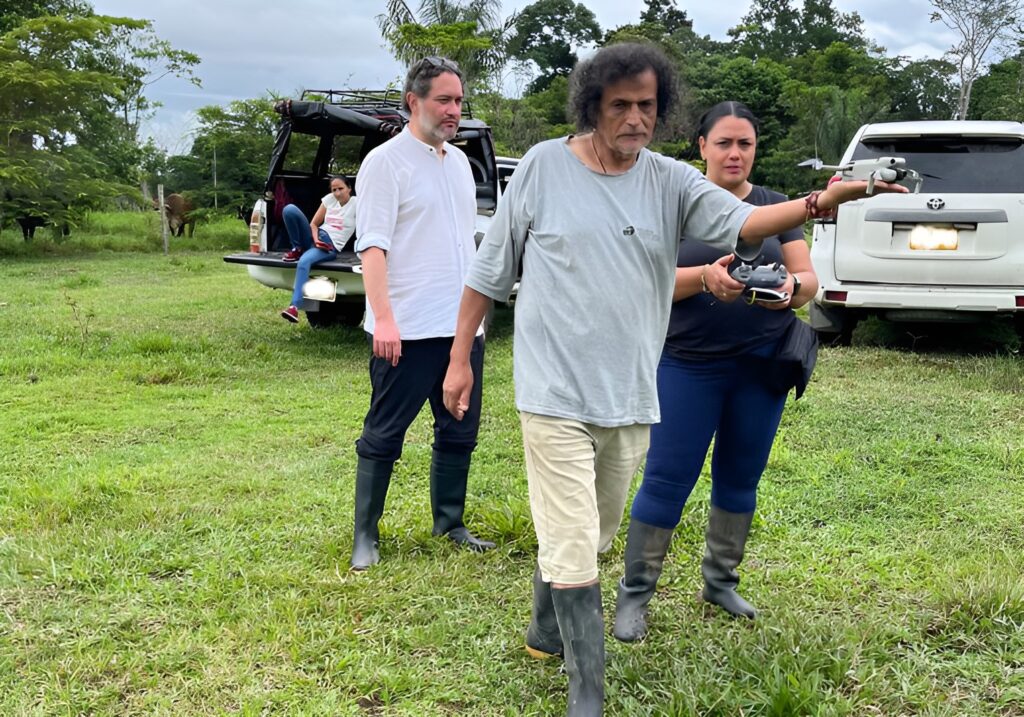
Dr Camilo Tamayo Gomez, based in Huddersfield’s School of Human and Health Sciences, heads up the initiative — known as Transmedia for Transitional Justice, or T4TJ — which blends community-driven research methods, AI analysis, mapping work, drone surveys and storytelling led by local people, applied to one of the toughest post-conflict situations anywhere in the world.
Huddersfield’s Centre for Archaeology is also involved, bringing expertise from previous work using ground-penetrating and other non-invasive survey techniques to locate burial sites tied to the Holocaust in Poland and the Ovaherero-Nama genocide in Namibia.
An estimated 150,000 people have been reported missing over the course of Colombia’s internal conflict. Despite the work of the country’s national search unit, progress has been slow, and conventional forensic methods struggle in remote areas where community trust and local knowledge are essential to making any headway.
Suspected burial sites
A second research trip to Caquetá, run alongside local grassroots group Escuela Audiovisual Infantil, has turned up two suspected burial sites, with early indications pointing to somewhere between 15 and 20 sets of remains — each one representing a family that has waited years, sometimes decades, for any kind of answer.
Dr Tamayo Gomez said: “This work belongs to the communities. What we are doing is creating the conditions in which their knowledge, their testimony, and their demand for justice can be heard and acted upon.”
Caquetá, a largely rural region acting as a gateway to the Colombian Amazon, saw armed groups exploit its remoteness, dense forest and limited state presence for decades. Paramilitary organisations, especially during their territorial expansion through the late 1990s and early 2000s, carried out serious violence against rural, Indigenous and campesino communities — including massacres, targeted killings, forced displacement and enforced disappearance — with victims’ bodies typically hidden away in secret burial sites or dumped in rivers and dense forest, a tactic meant both to destroy evidence and to instil fear in surrounding communities.
Researchers describe the search for Caquetá’s missing as something well beyond a technical or scientific exercise — a humanitarian and political process that offers families an end to prolonged uncertainty, restores dignity to victims, and rebuilds accounts of violence that were suppressed on purpose. Given how quickly evidence can be lost to shifting ground, ongoing danger and the environment itself, the team stresses that time is not on their side.
Commemorating the missing
Plans are now under way for a third trip focused specifically on exhumation, working alongside the university’s own archaeology team, Colombia’s national prosecutor’s office, and the communities directly affected — aiming not just to recover remains but to produce audiovisual material that commemorates the missing.
Dr Tamayo Gomez said: “The Centre of Archaeology’s Caroline Sturdy Colls, Kevin Colls and I have also been collaborating through the Reimagining Victims’ Reparation Global Network (RVRGN), which has provided an important space for bringing together different disciplinary perspectives on victims’ reparation, memory and transitional justice. Their involvement in this project builds on an existing collaboration and creates an exciting connection between our community-led work in Colombia and their extensive expertise in forensic and conflict archaeology.
“Caroline and Kevin bring considerable experience in non-invasive archaeological methods, archaeological and digital survey techniques, and the investigation of mass graves in complex contexts of genocide and mass violence. Bringing this expertise together with the local knowledge of communities, our participatory methodologies and the transmedia dimension of the project gives us the opportunity to develop an interdisciplinary and ethically-grounded approach to supporting the search for the missing in Colombia.”
This work is funded through Huddersfield’s Impact Acceleration Account, backed by the Economic and Social Research Council, which is also supporting separate university research into nursing workforce issues in Ghana, housing pressures facing NHS staff, obesity and mobility work carried out jointly with Calderdale and Huddersfield NHS Trust, and studies looking at compassion within organisations.