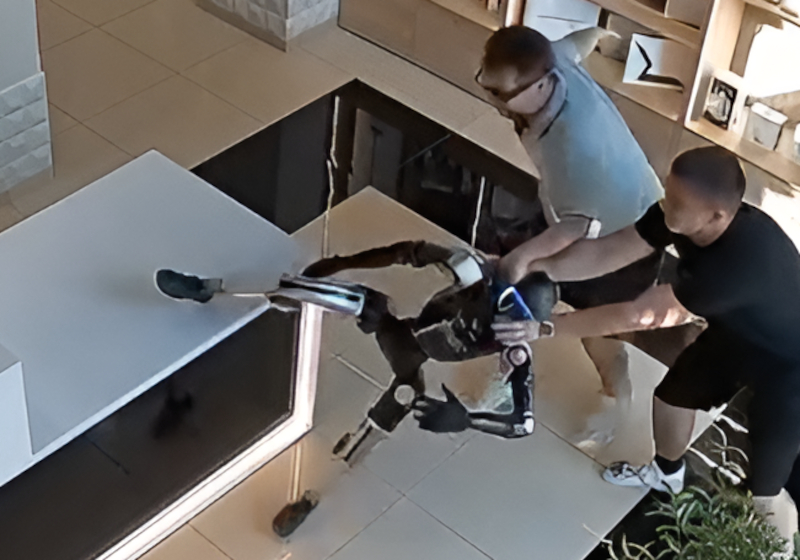

Millions have now watched the clip: CCTV-style footage from a Volga Store 64 electronics shop in Saratov, Russia, showing a customer shoving a humanoid robot named Syoma, and the robot apparently squaring up and throwing a series of kicks before staff step in.
It picked up more than five million views on a single repost alone – by the Turkish anti-clickbait account Boşuna Tıklama – within hours of going up on Tuesday 1 September 2026, and the “robot uprising” jokes haven’t stopped since.
What actually happened is still an open question. The shop’s own explanation, given to Luxembourg outlet L’essentiel, is that Syoma “lost control” and tried to attack the customer, a line delivered with more mischief than embarrassment: staff told the paper the robot is now in an “emotional reboot phase.”
Beyond that, reporting so far agrees on one thing only – nobody outside the shop has established whether the movement was a genuine malfunction, a remote operator having some fun, or a fully staged stunt.
No injuries have been reported. Anyone smell stunt?
Harold, Huddersfield’s most patient robot
While Saratov argues over its robot’s temper, West Yorkshire has a considerably calmer one. The University of Huddersfield introduced a Unitree G1 humanoid – the same model family behind Syoma – in late 2025, and students named him Harold, a nod to the Huddersfield-born former prime minister Harold Wilson.
He’s now the flagship robot of the university’s Institute for Applied Artificial Intelligence, launched in March 2026.
Harold made his television debut on ITV’s This Morning on Friday 27 February 2026, dancing alongside the presenters and showing off a few martial arts moves of his own – rather more choreographed than anything seen in Saratov. Behind the cameras, the work is less flashy.
Professor John Murray, pro vice-chancellor for teaching and learning at Huddersfield and the driving force behind the university’s AI research, is using Harold to explore assisted-living technology: the kind of everyday support that could help elderly or vulnerable people stay independent at home for longer.
The pavement wars of Sheffield
Not every robot gets a warm welcome. From March 2026, Starship Technologies ran a fleet of six-wheeled delivery robots – each about 56cm (1ft 10in) tall – around Sheffield, including the Meersbrook area, delivering for Uber Eats.
The charity Living Streets raised the alarm nationally as part of its Pavement Overload campaign, warning that robots like these were adding to pavement congestion that already makes life harder for wheelchair users, guide-dog owners and parents with pushchairs.
Catherine Woodhead, chief executive of Living Streets, said in the charity’s own statement launching the campaign: “At Living Streets, we believe that pavements are for people, and the operation of robots puts the safety of pedestrians at risk – particularly for those with mobility issues.”
Some Sheffield residents didn’t wait for the government to legislate. Over five months, the robots were repeatedly vandalised – safety flags snapped off, “off our street” painted across their shells, and more than one boxed in with traffic cones until it gave up and called for help. On 24 August 2026, Starship pulled the fleet.
“Our pilot in Sheffield has now come to an end, and we have paused the service while we review what we’ve learned,” Ryan Case, the firm’s public affairs and communication manager, told Retail Gazette. He told the BBC separately that vandalism was not behind the decision, describing it instead as “a commercial decision” and “a natural conclusion” to the pilot phase.
A similar fleet was still running in Leeds as of August 2026.
When the AI can’t follow a Yorkshire accent
The sharpest edge of all is in South Yorkshire’s GP surgeries. Looking to cut down brutal phone queues, several practices adopted EMMA, a nationwide AI phone-triage system built by QuantumLoopAI.
Healthwatch Rotherham went public with patient concerns on 10 July 2026, after speaking to local groups – deliberately including elderly and veterans’ groups – who found the system simply couldn’t understand them.
“One of the issues is this system can’t always understand what people’s inquiry is about due to their broad Yorkshire accent,” Kym Gleeson, Healthwatch Rotherham’s manager, told the BBC. “Across South Yorkshire, accents do vary quite a lot. There are different twangs so there’s a lot of variation.”
Some patients gave up on the phone altogether and walked to the surgery instead, she said, “especially if you’re feeling quite vulnerable due to ill health.”
QuantumLoopAI said EMMA is designed to understand a range of dialects and that patients can always ask to speak to a human.
Nobody in Yorkshire is being drop-kicked by a rogue shop-floor robot. But real automation is already deciding who gets a doctor’s appointment and who can get down the road safely with a wheelchair or a pram.
Less dramatic than a viral fight video. Rather more worth watching.