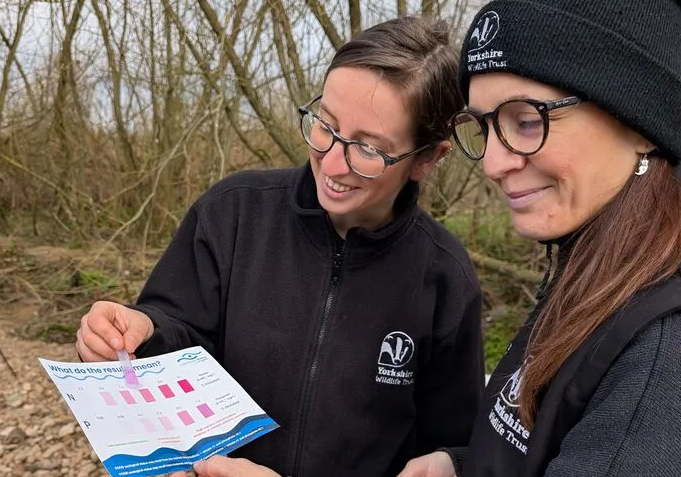

Nearly a quarter of river samples taken across Yorkshire’s Derwent and Aire catchments came back showing poor water quality during April’s Great UK WaterBlitz, prompting Yorkshire Wildlife Trust’s Rivers to Reef project to put out a fresh call for volunteers.
Almost 200 samples were gathered by volunteers across the two catchments during April, part of Earthwatch’s nationwide water sampling campaign, revealing a patchy state of health across the county’s waterways and underlining just how much continued citizen science still has to offer.
Rivers to Reef, run in partnership with the Aire Rivers Trust and the Yorkshire Derwent Catchment Partnership and backed by Yorkshire Water, aims to protect rivers along their entire length, from the hills and moorlands where they rise to where they meet the North Sea. The project grows Yorkshire’s citizen science capacity through standardised water testing, community litter surveys, and backing for the twice-yearly Great UK WaterBlitz, a nationwide effort to map river health.
In April, 197 samples were tested for nitrates and phosphate — two nutrients whose levels reveal a lot about a river’s condition. Both occur naturally and support healthy ecosystems, but too much of either can point to pollution from farm runoff, storm overflow discharges, misconnected pipework or urban development, and can trigger algal blooms that strip rivers of oxygen and damage the habitats living things depend on.
Sixty per cent of the samples earned a good overall nutrient score, with roughly one in four rated poor — 163 of the samples were taken in the Aire catchment and 34 in the Yorkshire Derwent catchment.
Major international importance
The stakes reach well beyond the rivers themselves. Yorkshire’s river network drains close to a fifth of England’s entire land area into the Humber Estuary, the largest single source of fresh water flowing into the North Sea and a site of major international importance for wildlife.
Despite that, the Humber’s ecological condition has been rated “unfavourable” for over ten years, with saltmarsh, seagrass meadows and shellfish beds all continuing to decline. The project takes a three-pronged approach to these challenges, pairing scientific monitoring with policy engagement and grassroots community action.
Ana Cowie, Marine Projects Manager at Yorkshire Wildlife Trust, said: “The Great UK WaterBlitz is giving us an invaluable snapshot of the health of Yorkshire’s rivers, but we need more boots on the ground to build an even clearer picture. The April results show that while many of our rivers are in good condition, there are still areas where nutrient pollution is affecting water quality.
“Every sample collected helps us identify pollution hotspots and better understand what’s happening across our catchments. We’re particularly keen to recruit more volunteers in the Yorkshire Derwent catchment so we can build a more balanced dataset and compare the health of both river systems in greater detail. Whether you’re an experienced volunteer or completely new to citizen science, taking part is quick, simple, and makes a real difference.”
Clare Beasant, River Health Improvement Manager at Yorkshire Water, said: “Healthy rivers and the seas that they feed depend on strong connections between people, organisations, and the watercourses that flow through communities. Combining local knowledge with scientific monitoring means that we can build a stronger understanding of our catchments, and better target actions that will deliver long-term improvements for river health.”
Volunteers can take part again when the next Great UK WaterBlitz runs across four days in mid-September, from the 18th to the 21st, with people across both catchments sampling over the same stretch to build a joined-up, county-wide picture. Nobody needs prior experience to join in — testing kits and guidance are supplied free to every participant.
Anyone wanting to sign up, or to read the full findings from April’s survey, can do so at ywt.org.uk/rivers-to-reef.