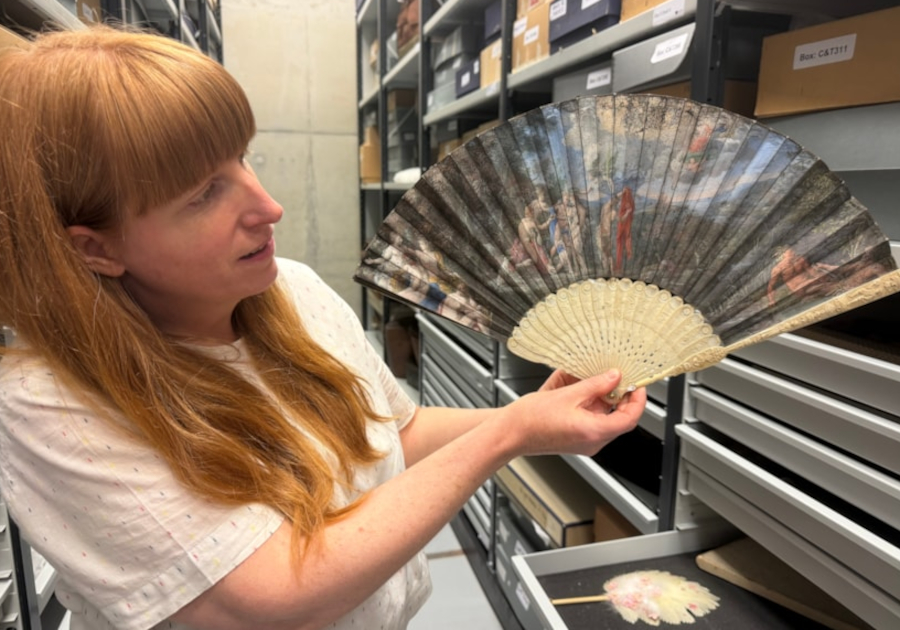

Curators in Leeds are cataloguing and conserving a striking collection of vintage fans, among them a fan roughly 350 years old that illustrates one of Greek mythology’s most consequential arguments.
Dating to around the 1680s, the folding fan has sticks carved from antique ivory and shows the Judgement of Paris — the myth in which a Trojan prince is forced to pick a winner in a beauty contest between three goddesses, with Aphrodite ultimately triumphing over her rivals Hera and Athena.
That decision, sealed with the gift of a golden apple, is traditionally blamed for setting off the abduction of Helen and, in turn, the decade of warfare that’s inspired centuries of storytelling.
It’s one of more than 400 fans held at Leeds Discovery Centre, most dating from the 18th and 19th centuries and once considered essential accessories for fashionable women, their designs often drawing on mythological romance, birdlife or East Asian motifs.
Themes of love and courtship
Natalie Raw, curator of costume at Leeds Museums and Galleries, said: “Although today we usually think of fans just being used to help us cool down in the hot weather, in the 18th century no lady’s dress would be complete without one. As well as being a beautiful fashion accessory, they were also associated with the idea of flirtation and the imagery painted on them would often signify themes of love and courtship.
“At dances and social gatherings, a lady might use subtle gestures with their fans, such as a flutter or a glance over the top, to attract attention or express she was interested in someone. These behaviours led to the popular belief that fans could be used as part of a secret code of communication between men and women.
“Today, they still look just as stunning and also give us a fascinating insight into how the use of elaborate and beautiful accessories has evolved over the centuries and what this tells us about the relationship between fashion and society.”
Hunting for antiques
A large share of the collection was put together around the turn of the 20th century, a period when hunting for antique fans became a favourite pastime among well-off collectors — among them Lady Gascoigne of Lotherton and Dorothy Una Ratcliffe, who married into West Yorkshire’s Brotherton family.
The identities of most of the original makers have been lost to time, though a handful of clues do survive: two of the fans carry the name of Sarah Ashton, a woman who worked as a printer in London’s Covent Garden during the late 1700s, one of them decorated unusually with plant-classification illustrations, and another covered in riddles, once owned by a Leeds woman named Isabel Kennedy. By the early 1800s, tastes had shifted towards plainer Georgian fashions, and smaller, more understated fans came into vogue.
Regular store tours at Leeds Discovery Centre give the public a chance to view the fans, and a handful are currently being shown at Lotherton, forming part of its ongoing Botanically Beautiful exhibition.
Councillor Salma Arif, Leeds City Council’s executive member for economy, said: “The many stunning examples of fashion and costume in the Leeds collection really do bring home the creativity and imagination of designers through the ages and how they captured the themes and trends of their individual eras. Our whole collection is an incredible archive of millions of years of history and it’s wonderful that the people of Leeds are able to visit and be inspired by it.”
Leeds Discovery Centre runs pre-booked tours and operates on a Give What You Can basis, meaning visitors are welcome — though not required — to make a donation, either online when booking or in cash at reception.