
Middlesbrough is about to take centre stage in the British art world. From 26 September 2026 until 29 March 2027, Mima will host the 2026 Turner Prize exhibition at Centre Square, Middlesbrough, open Tuesday to Saturday, 10am to 4.30pm, and Sunday, noon to 4pm, with free admission throughout.
Tate Britain announced the shortlist in April this year: Huddersfield-born Simeon Barclay, Kira Freije, Marguerite Humeau and Tanoa Sasraku. The winner will be announced on 10 December, at an award ceremony at Mima, and will receive £25,000, with £10,000 going to each of the three other shortlisted artists.
Founded in 1984, the Turner Prize is awarded each year to a British artist for what the judges consider the most outstanding contribution to art made in Britain over the previous 12 months.

Dr Laura Sillars, director at Mima and dean of culture and creativity at Teesside University, said: “This shortlist promises an extraordinary Turner Prize exhibition at Teesside University’s cultural heart, MIMA. We all look forward to working with the artists over the coming months in Middlesbrough, a place with a strong and growing cultural confidence. As the first Turner Prize within a university setting, this moment creates a special context, where contemporary art can inspire discussion, dialogue and new ways of thinking.”
Alex Farquharson, director of Tate Britain and chair of the Turner Prize jury, said: “It is a privilege to announce this outstanding shortlist – congratulations to all four nominated artists. The Turner Prize continues to offer the public a compelling reflection of the breadth and vitality of contemporary British art.
“This year’s selection presents a rich and diverse range of work, spanning installation and performance, and with a strong emphasis on sculptural practice. Each artist invites us into carefully constructed scenarios, both real and imagined, that offer distinct perspectives through which to explore the world around us, and to reflect on our place within it.”
The four-strong jury also includes Sarah Allen, head of programme at South London Gallery; Sook-Kyung Lee, director of the Whitworth and professor of curatorial practices at the University of Manchester; Alona Pardo, director of the Arts Council Collection; and Joe Hill, director and chief executive of Yorkshire Sculpture Park, giving this year’s judging panel its own direct Yorkshire connection alongside the shortlist itself.

Simeon Barclay was born in 1975 to West Indian parents. Barclay’s path to the Turner Prize began far from the art world. He spent his early working life in the manufacturing industry in the North of England before attending night school and going on to study art formally, gaining a BA from Leeds Metropolitan University in 2010 and an MFA from Goldsmiths, University of London, in 2014.
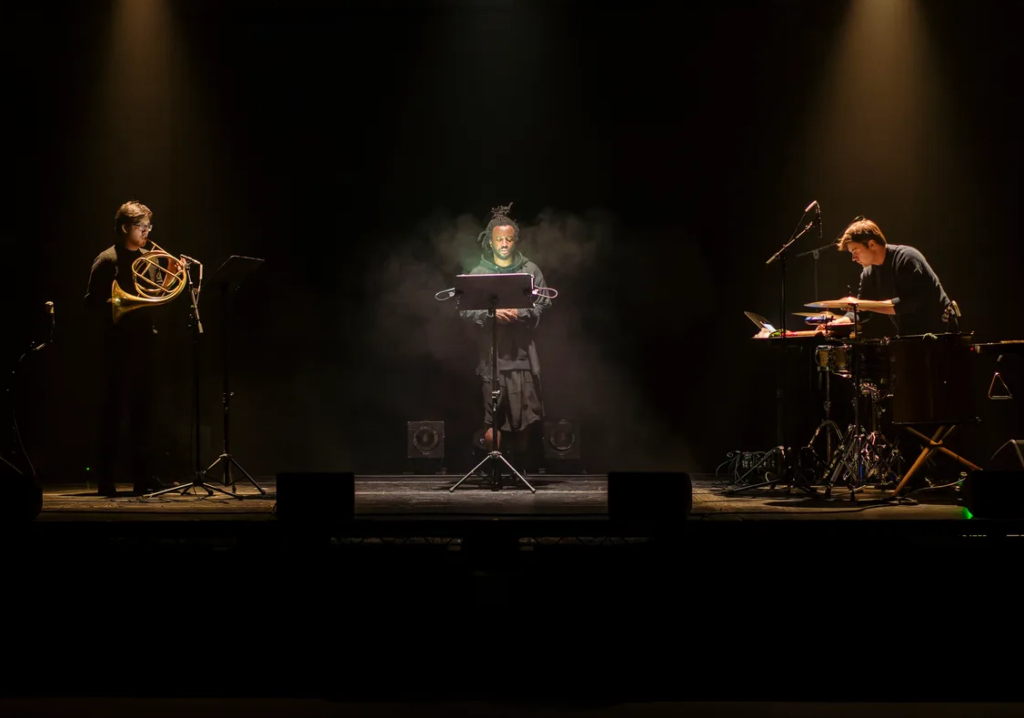
His nomination recognises The Ruin, his debut performance work, commissioned and first presented by the Roberts Institute of Art. The hour-long piece combines spoken word with live percussion by James Larter and horn by Isaac Shieh, drawing directly on Barclay’s Huddersfield upbringing and his lived experience of the industrial landscape of northern England in the 1980s and 90s. Tate’s own shortlist announcement states
The Ruin was presented at the ICA in London, at the Hepworth Wakefield, and at New Art Exchange, Nottingham. The Hepworth Wakefield leg took place in May last year, commissioned as part of a year-long research and development period with the Roberts Institute of Art, staged against the backdrop of Barbara Hepworth’s sculptures and the River Calder.
The Turner Prize jury praised the work for its exploration of “Britishness, class, race and masculine identity, through an evocative, experimental use of language and a psychologically immersive soundscape.”
Barclay currently holds the Kenneth Armitage London Fellowship, a two-year residency in sculptor Kenneth Armitage’s former London studio, and has work on display as part of Art Outdoors at Yorkshire Sculpture Park. His work is held in public collections including the Arts Council Collection and Manchester Art Gallery.

Kira Freije was born in London in 1985 and studied Fine Art at the Ruskin School of Drawing and Fine Art, University of Oxford, graduating in 2011, before completing a Postgraduate Diploma at the Royal Academy Schools in London in 2016.
Her nomination recognises Unspeak the Chorus, described by Tate as her first major solo exhibition, staged at the Hepworth Wakefield, West Yorkshire, from November last year to May 2026, the same venue that hosted Barclay’s nominated performance.
Freije works in metal, fabric and found materials, and the show featured a theatrical tableau of life-size figures built from bare metal armatures and stonecast faces. The jury praised “the emotional depth of Freije’s work, highlighting its unique sculptural vocabulary of materials and forms, as well as the haunting, expressive way she transformed the space through her arrangement of figures.”
Marguerite Humeau, born in 1986 and raised in Beaupréau, France, is a French artist based in London, nominated for her solo exhibition Torches, presented at ARKEN Museum of Contemporary Art in Copenhagen and Ham Helsinki Art Museum.
Her work examines the formation of life, ancient human history and imagined future worlds, and the jury said it “was impressed by her cinematic exhibition-making, and her engagement with ecological and existential themes through inventive forms, speculative scenarios and dynamic shifts in scale.” She is represented by White Cube.
Complex historical issues
Tanoa Sasraku was born in Plymouth in 1995 and graduated from Goldsmiths in 2018, going on to complete further study at the Royal Academy Schools in 2024. She is nominated for Morale Patch, her solo exhibition at the ICA in London exploring geopolitical ideas and recent political and military histories of oil through object-like sculptures and works on paper. The jury praised “the precision and sophistication of the installation, noting how it addresses complex historical issues with strong contemporary resonances, and its use of a clinical, minimalist display that conveys both irony and seriousness.”
All four artists’ work will be on show at Mima throughout the exhibition’s run, giving Yorkshire audiences an unusually close look at the region’s own representative among this year’s four Turner Prize nominees.
In December, the jury will choose the overall winner at Mima. Entry is free, though visitors are advised to book tickets in advance given the scale of interest expected.