
Cornwall has been insufferable about 1999 for the best part of three decades now. Total eclipse, total darkness, total bragging rights. Meanwhile, the rest of us made do with a slightly moody Tuesday.
This time round, nobody in the UK gets totality — that’s reserved for Greenland, Iceland and northern Spain — but the whole county, from the Dales to the coast, gets the deepest partial eclipse Yorkshire has seen since, and it lands on a Wednesday evening in August, low over the western horizon, wherever in the county you happen to be standing.
Bring a chair. Don’t bring your sunglasses. More on that shortly.
Coverage barely shifts across a county the size of Yorkshire — this eclipse changes far more travelling from London to Edinburgh than it does travelling from Sheffield to Scarborough — but here’s our best estimate for the major towns and cities, built from the confirmed regional data points published by the Royal Astronomical Society and BBC Sky at Night Magazine (London 91%, Newcastle 92%, Edinburgh 91%, Cardiff and Belfast 93%).
Yorkshire sits neatly between London and Newcastle on that scale, so expect the whole county to land in a tight band around 91–92%.
| Town / city | Estimated coverage |
|---|---|
| Sheffield | ~91% |
| Leeds | ~91% |
| Bradford | ~91% |
| Wakefield | ~91% |
| Doncaster | ~91% |
| Huddersfield | ~91% |
| Harrogate | ~91–92% |
| York | ~91–92% |
| Hull | ~91–92% |
| Middlesbrough | ~92% |
| Scarborough | ~92% |
The differences across Yorkshire are small enough that “roughly nine-tenths of the Sun, wherever you’re stood” is the honest headline figure. For an exact reading for your postcode, timeanddate.com‘s eclipse calculator will do the maths down to the minute and the decimal point.
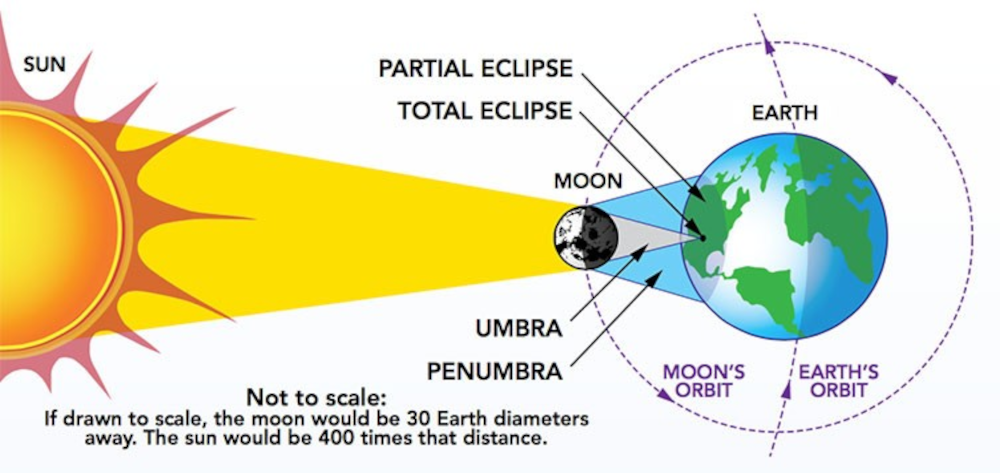
A solar eclipse happens when the Moon slides directly between the Sun and Earth, briefly blocking out daylight. Where the Moon’s shadow is darkest — the umbra — onlookers get a total eclipse; step outside that narrow path, into the paler penumbra, and you get a partial one, which is what the whole of the UK will experience this time.
The Natural History Museum, which has been fielding eclipse questions all summer, notes that total solar eclipses happen every 18 months or so somewhere on Earth, but any single spot on the planet only sees one roughly once every 400 years — which is why 1999 still gets talked about at dinner parties.
This particular eclipse begins shortly after 6pm on 12 August and peaks around 7.10pm across Yorkshire, with totality tracking across Greenland, Iceland and Spain — the first total solar eclipse over mainland Europe in 27 years, according to the Royal Astronomical Society. The UK misses out on full darkness, but not by much, and Yorkshire’s evening will play out low in the western sky as the Sun heads for the horizon, the light dimming noticeably without ever quite going properly dark.
It’s the best UK coverage since 1999, and nothing will beat it again until 23 September 2090 — so if you were planning to skip this one, the next chance is currently scheduled for your great-grandchildren.
What will it look like?
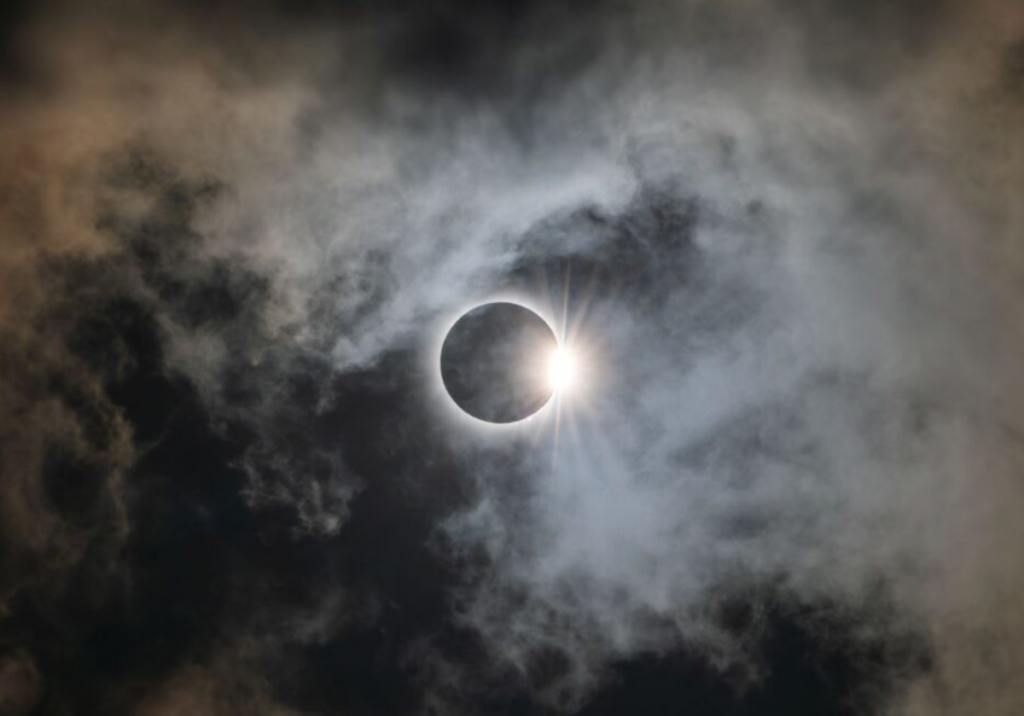
Don’t expect the collapsing-sky drama of a total eclipse — that’s reserved for the sliver of Europe standing directly in the Moon’s shadow.
What Yorkshire gets is subtler: a gradual dimming, a slight chill in the air, and — if you’re using proper kit — a Sun reduced to a thin, glowing crescent low over the rooftops.
The Natural History Museum’s Ken Phillips, who has watched four total eclipses and taken measurements during three, describes the run-up vividly: “A total solar eclipse is an amazing and totally unique experience,” he says, with the landscape turning mysteriously dark and taking on an eerie yellowish colour as the Sun disappears.
Yorkshire won’t get the full version — no black disc, no corona, no stars popping out at 6pm — but the light will still do something faintly unsettling to anyone paying attention, and that’s worth ten minutes of anyone’s evening.
Watch your eyes
Here’s the one paragraph in this whole feature you’re not allowed to skim. The UK Health Security Agency is blunt about it: looking at an eclipsed Sun is more dangerous than looking at a normal one, not less, because the dimmed light suppresses the blink-and-look-away reflex that would usually protect you, while the Sun’s radiation still reaches — and can silently damage — your retina.
It doesn’t hurt while it’s happening. That’s exactly the problem.
After the 1999 eclipse, the Royal College of Ophthalmologists logged around 70 cases of eclipse-related vision damage, close to 40% of them in people who’d looked for under a minute. Ordinary sunglasses do nothing to prevent this — however dark the lenses, they don’t block the wavelengths that do the damage, and by cutting the glare they can make it feel safer to stare for longer, which is worse, not better.
If you want to look directly at it, you need genuine eclipse glasses or a handheld solar viewer certified to ISO 12312-2:2015(E), bought from a reputable astronomy supplier, with no scratches, tears or pinholes in the filter. If in doubt, don’t use it.
The far simpler option needs no kit at all: a pinhole projector (a pinprick in a card, held up to project the Sun’s image onto a second card), a kitchen colander held the same way, or — genuinely — standing under a tree and watching the crescent-shaped shadows the leaf canopy throws onto the pavement, each gap in the leaves acting as its own tiny pinhole camera.
RAS President Professor Jim Wild puts it simply: “Never look directly at the Sun without appropriate solar viewing equipment.”
Certified glasses, solar filters on telescopes and binoculars, or a pinhole projector are the only ways to do this properly.
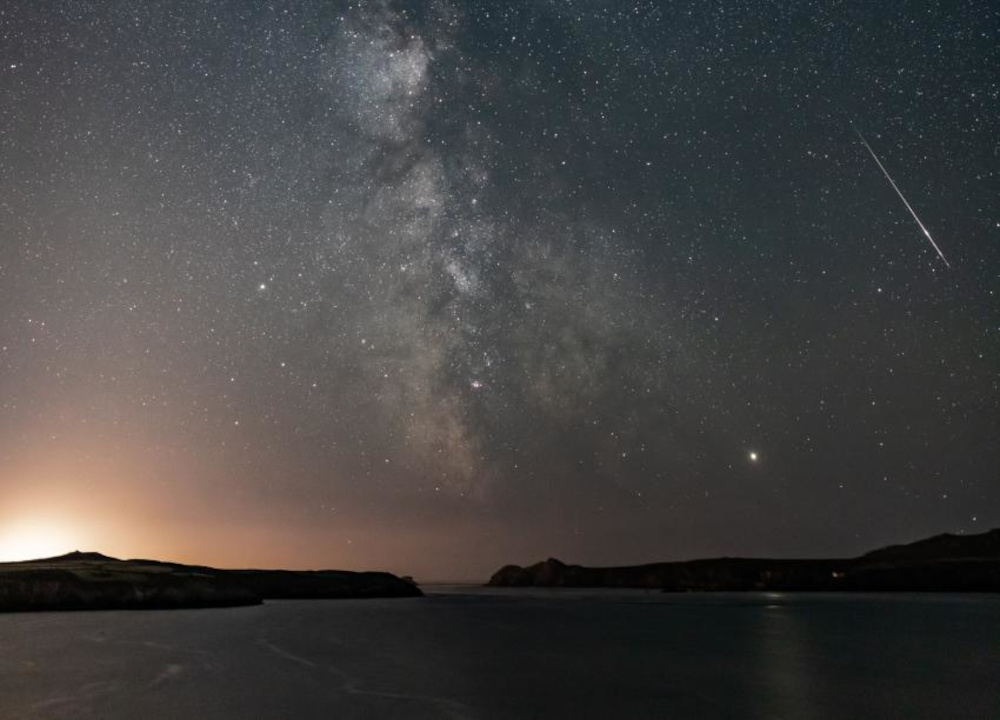
As if one celestial event wasn’t enough, the eclipse falls in the middle of the best meteor shower of the year. The Perseid shower peaks overnight on 12–13 August — the same 24 hours as the eclipse — and this year the timing is close to perfect: the Moon is new, meaning no wash of moonlight to drown out the fainter meteors.
The British Astronomical Association’s Meteor Section director, Dr John Mason, expects rates of 50–70 meteors an hour from a genuinely dark site at the peak, dropping but still worthwhile from town.
The Perseids are debris from comet Swift-Tuttle, burning up as Earth ploughs through the trail it left behind; the dust hits the atmosphere at roughly 131,000mph, and the shower is reliably the most fireball-heavy of the year, according to NASA data cited by the BAA. Peak viewing is the pre-dawn hours of 13 August, when the shower’s radiant — near the Perseus-Cassiopeia border — climbs highest in the sky, though earlier “earth-grazing” meteors, seen when the radiant is still low, tend to be fewer but longer and more dramatic.
No kit required beyond a dark spot, a blanket, and a willingness to be up at 2am on a work night.
…and a lunar eclipse
Yorkshire’s sky calendar isn’t finished with the eclipse. On 28 August, a partial lunar eclipse is due at 3.33am BST for the start, building to maximum eclipse at 5.12am — when around 90% of the Moon sits inside Earth’s darkest shadow, the umbra — before fading out as the Moon sets around 6.15am, according to the Royal Observatory Greenwich.
It’ll be low over the south-western horizon throughout, so a clear sightline in that direction will work best. But if you’re up at 5am, we’re pretty sure you already knew that.
A lunar eclipse works in reverse to a solar one: Earth sits between the Sun and Moon, casting its own shadow onto the lunar surface. When the alignment is close to perfect, the Moon can turn a deep coppery red — the so-called “blood moon” effect, caused by sunlight bending through Earth’s atmosphere and scattering out the blue end of the spectrum before it reaches the Moon.
This one’s a partial rather than a total, so don’t expect the full blood-red spectacle, but a visibly darkened Moon low over Yorkshire at 5am is still a better start to the day than most.
Historically, eclipses had a rough reputation. Ancient cultures across the world tended to read a vanishing Sun as something closer to disaster than astronomy — a demon devouring it, an angry god, or, per one Californian tradition the Natural History Museum notes, a bear taking a bite out of it mid-fight.
Some modern superstitions about eclipses and pregnancy persist too. But the only genuine risk here is to unprotected eyes, spread the word about that as your eclipse good deed.